
Product Engineering - Quality Management
Incidents in the 8D problem solving method
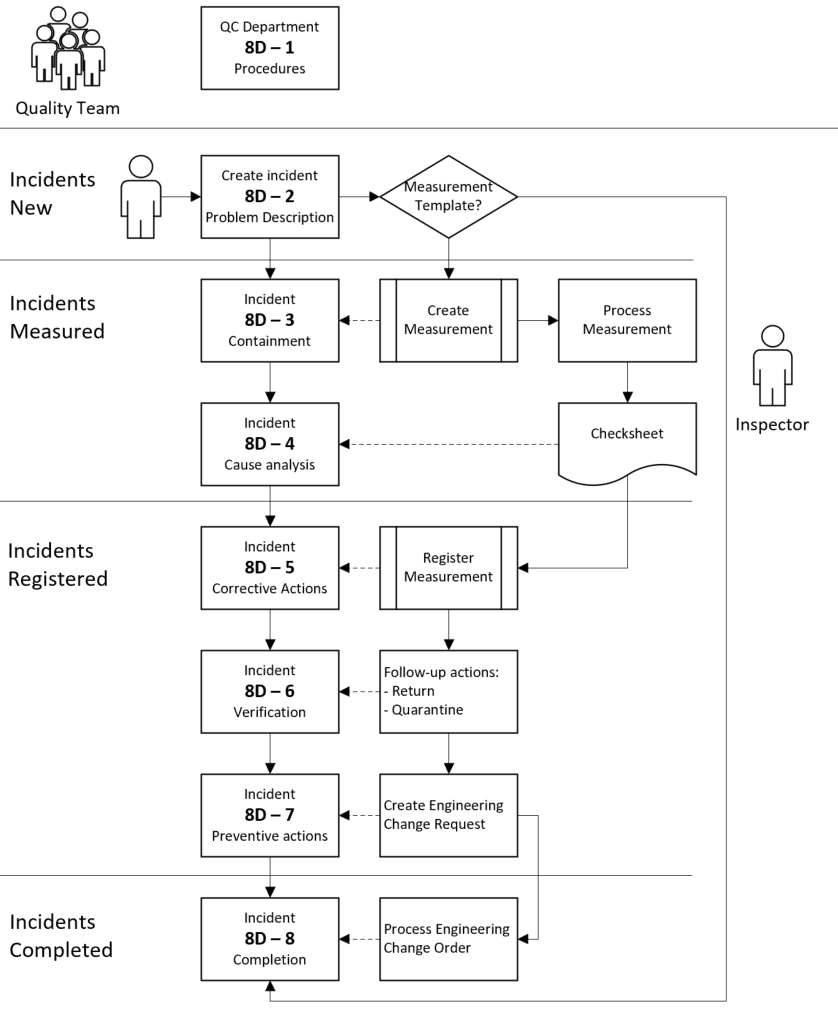
8D-1: Team formation
Quality Management assumes that a QC department (team) is responsible for managing the process around incidents, defining and maintaining measurement templates, processing measurements, and taking follow-up actions on registered measurements.
8D-2 and 3: Incident creation and containment
An incident is created when a measurement template is found in the item, item category, standard task, or service group template. Alternatively, create incidents manually through the Create Incident Wizard. The wizard also allows you to create incidents of the type Man, Machine, and Method, while automatically created incidents are always of the type Material.
When the items are serial or lot controlled, the information card is blocked to prevent items from being selected in other processes.
The program then checks if the Automatic Create Measurements setting in the Quality Management setup is on. When true, the measurement is created as per the measurement template.
8D-4 and 5: Analysis and corrective actions
The measurement specifies how the analysis must take place by setting the sampling method and creating the check sheet from the question set.
The sampling method determines if a physical inspection is required and how many samples must be analyzed. Several sampling methods are available: from simple fixed or percentage-based quantities to more advanced statistical AQL or Zero Defects methods.
The check sheet specifies the criteria that need to be met (questions to be answered) to determine if the samples are Accepted or Rejected. Different types of questions (Boolean, Lookup, Numerical, and Text) are available, each with specific types of answers, from a simple Yes/No, through several-choice type lookups to target values with different tolerance levels.
A rating system with scores per answer and weights per question helps the inspector determine a Good, Average, or Bad result.
When the check sheet is reported complete, the inspector might decide to apply the result to the remaining lots in the same measurement (First Lot/Serial Approval) or to create the next check sheet in the same measurement (Recurring check sheets).
8D-6 and 7: Verification/Registration and follow-up actions
Once check sheets are completed, verify them before approving. When necessary, trigger re-tests for a "second opinion." When approved, the measurement is ready to be registered.
From the registered measurement, start follow-up actions such as creating a return order to the vendor, moving the goods to a quarantine location, or creating an engineering change request.
8D-8: Closing the incident
In the final step, close the incident. Closing is only possible when all related measurements and to-dos are completed.
See also